
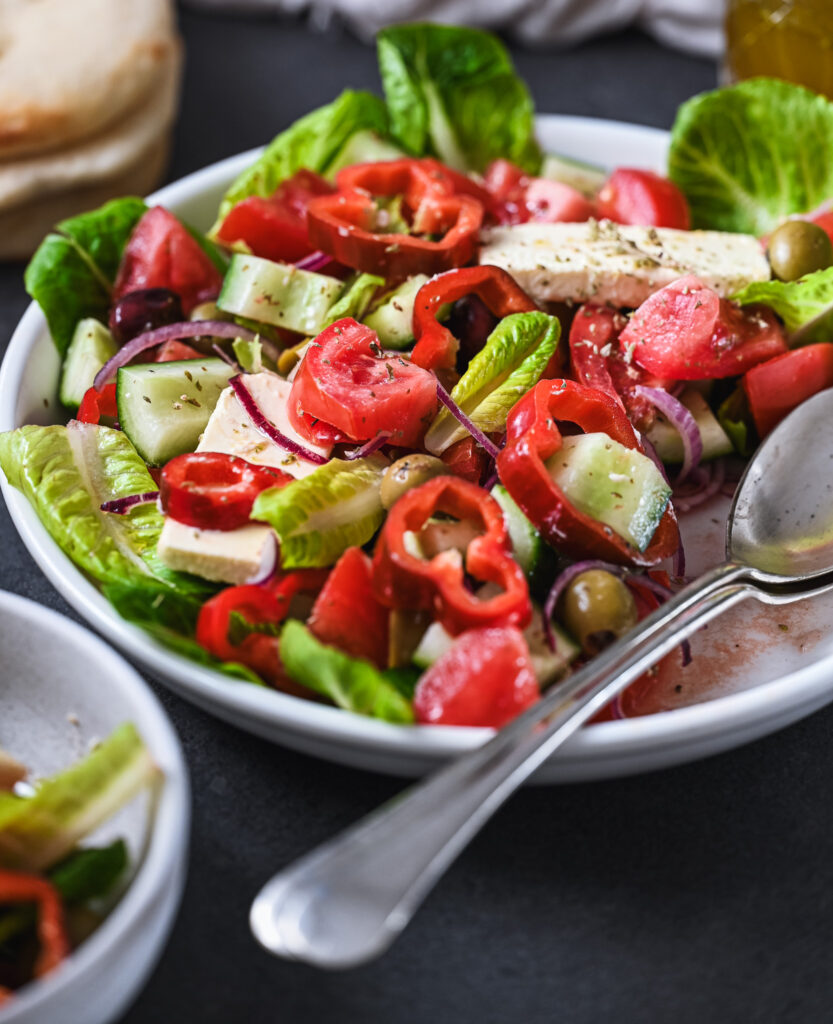
Greek Inspired Salad

A fresh, colourful Greek-style salad inspired by a visit to Oikos in Miramar, Wellington — ripe tomatoes, crisp cucumber, red pepper, olives and feta tossed in a bright red wine vinegar dressing. Simple, honest, and full of vibrant Mediterranean flavour.
Category: ,

Greek salad is one of those dishes where the quality of your ingredients really shows. When the tomatoes are ripe and at room temperature and the cucumber is crisp, you barely need to do anything – just simple chopping and a good dressing. I like to keep the vegetables roughly the same size so every mouthful feels balanced. It’s fresh, colourful, and the kind of salad that sits beautifully alongside almost anything from the barbecue.


Introduction

After finally managing to get a table at Oikos — the neighbourhood Greek restaurant everyone talks about — I went with my daughter, who’s a regular there. I’ve tried many times to book last minute on the off chance and never succeeded, so this time I booked a week ahead to make sure we got in.

There’s nothing fancy about Oikos, and that’s exactly what I loved. The food is simple, generous, and built on good ingredients treated with care — the kind of cooking that makes you slow down and appreciate each bite. Their village salad wasn’t called a Greek salad, and it didn’t include capsicum at all, but something about its freshness and simplicity really stayed with me.

This recipe isn’t a traditional Greek salad — it’s my version. I’m not a fan of green capsicum, and my husband loves red capsicum, so that’s what I use. And, being me, I can never resist adding a few handfuls of cos for extra freshness and lightness. It makes the salad feel more substantial without taking anything away from the flavours I love.

Ripe tomatoes (always at room temperature), crisp cucumber (I deseed mine, as Oikos did), red capsicum, a handful of olives, and good feta come together with a bright, oregano-laced dressing. Keep the vegetables roughly the same size so everything feels balanced and inviting. It’s the sort of salad that belongs in the centre of the table, ready to be shared — just like the food we enjoyed that night.
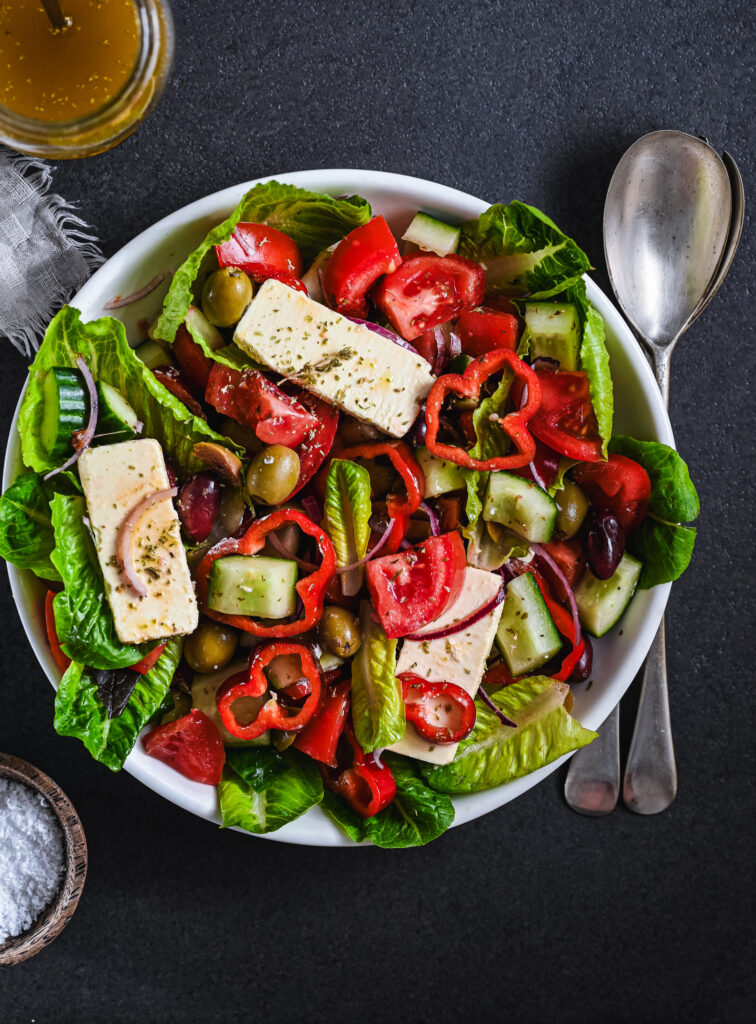

Greek Inspired Salad

20 minutes

Cook Mode: OFF

Ingredients

1/2x
1x
2x
4x
Servings: 4

Salad

  • 4 medium-large ripe tomatoes, cut into wedges then halved
  • 1 telegraph cucumber, sliced in half lengthways, seeds removed and sliced
  • 1 red capsicum (I used a king sweetie), chopped into even sized pieces
  • .5 small red onion, thinly sliced
  • .5 olives, whole (with pits, if you want to be traditional)
  • 100 feta, cut into thick slices (or cubed)
  • a handful of baby cos lettuce leaves

Dressing

  • 4 extra virgin olive oil
  • 1 red wine vinegar
  • 1 dried oregano
  • .5 honey (not traditional – optional)
  • .5 flaky salt

Directions

  1. Make the dressing
    In a small jar or bowl, whisk together the red wine vinegar, olive oil, oregano, salt, and honey until combined.

  2. Assemble the salad
    Add the tomatoes, cucumber, red capsicum, red onion, cos lettuce and olives to a shallow bowl or platter. Pour the dressing over the vegetables and toss gently to coat. Scatter the feta over the top.

  3. Serve
    Greek salad is best eaten right away, while the tomatoes are juicy and the vegetables still crisp.

Tips

  • Use ripe tomatoes at room temperature –Tomatoes are the heart of a Greek salad. Cold tomatoes lose flavour — room temperature ones give you sweetness, juice, and fragrance.


  • Keep the vegetables a similar size – Not tiny, and not oversized — just roughly the same. This isn’t about getting every ingredient on one fork; it’s about balance and making the salad easy to eat. Consistent pieces help the flavours mingle and the whole bowl look inviting.


  • Olives matter – Use the best you can find — Kalamata or big green Halkidiki are ideal. Pitted or unpitted is up to you, but whole olives have better flavour.


  • Salt just before serving – Salt draws out the juices from the tomatoes and cucumber, creating that lovely, naturally seasoned dressing at the bottom of the bowl. Add it too early and the tomatoes start to collapse and the cucumber softens.


Feta 101

  • Traditional Greek feta is made from sheep’s milk, often with up to 30% goat’s milk added for balance. It’s tangy, salty, and naturally a little crumbly — the flavour is stronger and more complex than the creamy cow’s-milk fetas many of us find in New Zealand supermarkets.
  • Cow’s milk feta (often labelled “Danish-style” or “feta-style”) is softer, milder, and creamier. It’s not traditional, but it’s delicious in its own way — especially if you prefer a softer texture.


Which should you choose?

Use whichever style you enjoy most. A crumbly Greek feta gives a more authentic flavour, while a creamier cow’s milk feta adds richness and softness to the salad. Both work beautifully.

Equipment

Share this Recipe

More Recipes

Blogs

Comments

Leave a Reply

Your email address will not be published. Required fields are marked *

Kia ora, and welcome to Māia.

I believe food should be nourishing, joyful, and shared. Māia is about giving you confidence in the kitchen and making the everyday a little more delicious. I’m Colleen, and I’m so glad you’re here

Get in Touch

Have a question, recipe idea, or just want to say kia ora? Drop me a message below — I’d love to hear from you!

Contact Forn

Tips

  • Use ripe tomatoes at room temperature –Tomatoes are the heart of a Greek salad. Cold tomatoes lose flavour — room temperature ones give you sweetness, juice, and fragrance.


  • Keep the vegetables a similar size – Not tiny, and not oversized — just roughly the same. This isn’t about getting every ingredient on one fork; it’s about balance and making the salad easy to eat. Consistent pieces help the flavours mingle and the whole bowl look inviting.


  • Olives matter – Use the best you can find — Kalamata or big green Halkidiki are ideal. Pitted or unpitted is up to you, but whole olives have better flavour.


  • Salt just before serving – Salt draws out the juices from the tomatoes and cucumber, creating that lovely, naturally seasoned dressing at the bottom of the bowl. Add it too early and the tomatoes start to collapse and the cucumber softens.


Feta 101

  • Traditional Greek feta is made from sheep’s milk, often with up to 30% goat’s milk added for balance. It’s tangy, salty, and naturally a little crumbly — the flavour is stronger and more complex than the creamy cow’s-milk fetas many of us find in New Zealand supermarkets.
  • Cow’s milk feta (often labelled “Danish-style” or “feta-style”) is softer, milder, and creamier. It’s not traditional, but it’s delicious in its own way — especially if you prefer a softer texture.


Which should you choose?

Use whichever style you enjoy most. A crumbly Greek feta gives a more authentic flavour, while a creamier cow’s milk feta adds richness and softness to the salad. Both work beautifully.

Equipment